The taxi driver was doing about 70 on the highway outside Miami when he turned around in his seat and looked at me.
He was a big guy, maybe 35, Cuban, with good English. He had asked where I was flying in from. I told him Havana. Then I told him about Leonel and Maria and the baseball game.
"You really did all of that for them?"
I said yes. His eyes welled up. This big, tough guy, weaving through Miami traffic, and I could see the tears sitting at the bottom of his eyes.
"That young couple," he said, "will name their children after you."
Here is how I ended up in that back seat.
Getting to Cuba
In July 2012, an American could not just book a trip to Cuba. The United States has had an embargo on Cuba since the early 1960s. To go legally, you needed a license from the Office of Foreign Assets Control.
I went on an arts exchange program, with a small group organized by Chamber Exploration. There were 15 or 20 of us, from places like Ocala, Florida, and the Carolinas. I didn't know a single one of them. There were no commercial flights from the US to Cuba, so we flew down on a charter.
Cuba is 90 miles from Florida. Tourists from Europe and the rest of the world could go there. Several generations of Americans never had the chance. I wanted a real look at the place.
A Hilton stuck in time
We stayed at the Hotel Habana Libre. It opened as the Havana Hilton in 1958. Then the revolution overthrew the Batista government, and Castro's government took over every business, that hotel included.
When I was there, it was still a hotel from that era. Nice, but dated. And the Hilton logo was still in the mosaic tile at the bottom of the pool. Changing it would have cost a lot of money. So they named the hotel the Habana Libre, and the H from the Hilton logo still works.
Magic doesn't need a translator
I went hoping to do magic and comedy for people where they live. I busked on sidewalks. I did shows in a park, in a couple of restaurants, and in people's homes.
Most of the people I met didn't speak English, and I speak a few words of Spanish. That's where magic earns its keep. It's all visual, so we laughed together without a common language.
Most of them had never met an American, let alone had one do magic in their living room. They were thrilled, and they were grateful.
A lot of people take candy on trips like this. I took baseballs. Baseball is Cuba's national sport, and every kid there grows up wanting to play. I gave baseballs away, and they were a hit.
How do you get home from a ballgame in Havana?
It was summer, which meant baseball season. Back at the hotel, I asked the concierge, about the only person there who spoke English, if I could see a game.
Estadio Latinoamericano was not far away. Could I walk there? No, too far. Could I take a taxi? Yes. Would a taxi be waiting when the game let out, like at a ballpark back home?
No. Most Cubans can't afford a taxi, so the taxis stay in the hotel and tourist districts. Nobody waits outside the stadium.
So I started negotiating. What if I asked my driver to come back for me? He won't. What if I paid him half the fare up front? He still won't. What if I paid the whole fare? Then he definitely won't. You've already given him all the money.
"Well," I said, "what if I take him with me?"
The concierge looked at me in awe. "You would seriously do that?"
Almost every taxi driver I saw there was a young man, and all of them loved baseball. So why not?
He whistled a driver over. His name was Leonel. The concierge said something to him in Spanish. The only word I caught was "béisbol." Leonel looked at me, and we jumped in his car.
"Really?"
With some pantomime, and by pointing at the wedding ring on my left hand, I asked Leonel if he was married. He was. His wife's name was Maria.
Cubans almost always work close to home, because commuting costs money they don't have. So I asked him, "Can we go get Maria and take her to the game too?"
Leonel turned all the way around. His eyes were as big as saucers, and he said the first English word I had heard from him.
"Really?"
"Yes. Absolutely."
"Sí, sí, sí."
He called her on his cell phone. When we pulled up, Maria came bounding out of the house and jumped in the front seat. I rode in back, in an old American car painted with house paint and running on a Russian engine. The embargo keeps American parts out, so it was Russian parts all the way through.
Maria knew 50 or 75 words of English. That was enough for a real conversation.
Where the language barrier disappeared
Tickets were about three dollars each. That got us the best seats in the house, on the first base line behind the dugout. Back home, seats like that at a Major League ballpark would cost a couple of people more than $200.
Once we sat down, the language barrier all but disappeared. Cuban baseball uses the American words. First base is "first base." A home run is a "home run." A hit is a hit, a pitch is a pitch, and the third baseman is the third baseman.
I wanted a picture of the three of us, so I asked a policeman to take one with my phone. Leonel tried to stop me. The police there could do whatever they wanted, and he was afraid we would get in trouble just for talking to one. I didn't know any better. I walked up with my American attitude, and some American arrogance, I suppose, and asked anyway.
The policeman said yes. I still have that photo: Leonel, Maria and me, with the fans and the game going on behind us.
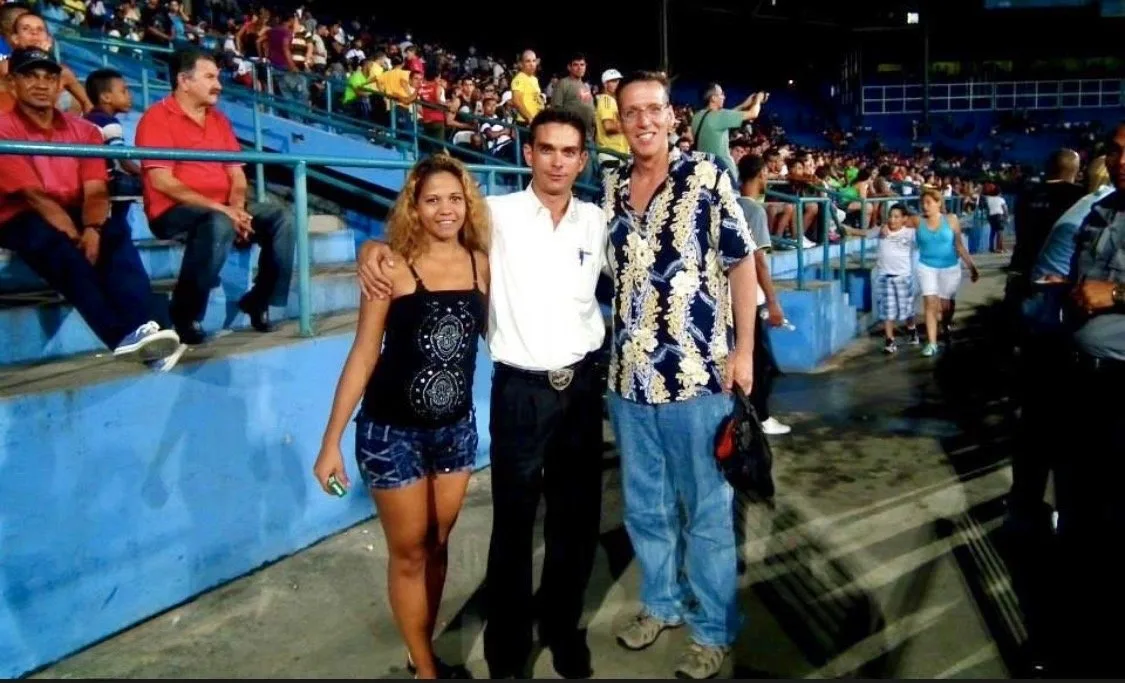
Everyone sitting around us knew I was an American. They were excited to have me there, and I was just as happy to be with them. A vendor came by selling popcorn for 10 or 15 cents, so I bought popcorn for everybody.
The ride to Fort Lauderdale
The charter brought me back into Miami, but my flight home to Ohio left from Fort Lauderdale. So I grabbed a cab between the two airports.
My driver had come to the US from Cuba. Back then, you could only go to Cuba if you had family there or a reason the US government accepted. He didn't know many people outside the Cuban community who had been. When I told him about the arts exchange, he wanted to hear all of it.
So I told him about Leonel and Maria. That's when he turned around at 70 miles an hour.
What I brought home
I went to Cuba with a bag of baseballs and a few magic tricks. Neither one needed a translator.
The ticket cost three dollars. The popcorn cost pennies. What moved a grown man to tears on a Miami highway was that I invited two people to come along.
It was a magnificent feeling, knowing I could touch people's lives that way. It made a big, tough guy cry, and it put smiles on dozens of faces in a single night.