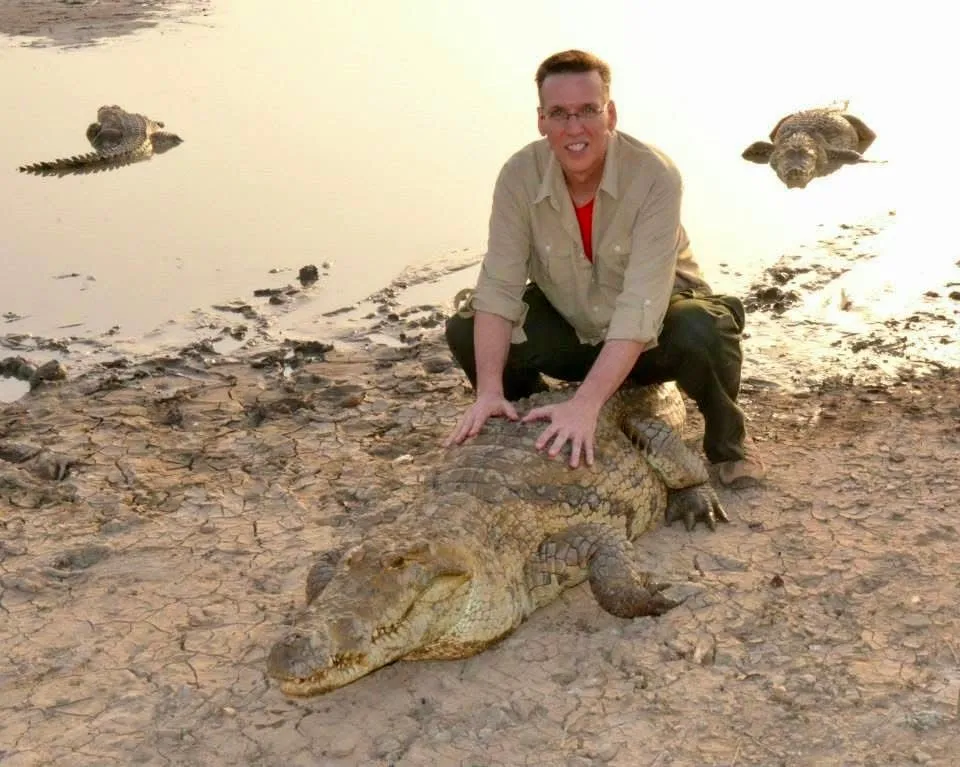
The man from the village held a long, thin stick in one hand and a live chicken in the other.
He waved me down toward the water and pointed at a crocodile that had pulled itself up onto the bank. He wanted me to sit on its back.
All around me were dozens more. Five and six feet long, and every bit as fierce looking as you would imagine.
The chicken was the plan. If a crocodile got aggressive, he would toss the chicken in front of it. The crocodile would eat the chicken instead of me.
I am happy to report that I was not eaten. We didn't need the chicken to save my life. But we did give it to the crocodile anyway, as a reward for good behavior.
The sacred crocodiles of Bazoule
This was 2013, a few months after my trip to Guatemala. I was in Bazoule, a small village about 20 miles west of Ouagadougou, the capital of Burkina Faso, in West Africa.
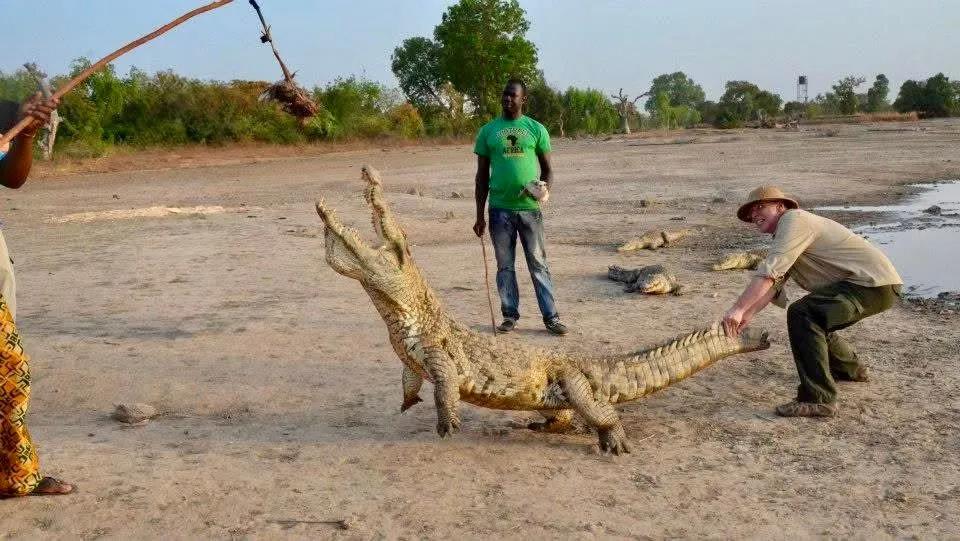
The village has a large pond that is home to well over 200 West African crocodiles. The story goes back to the 1400s. There was a drought, as there so often is in that part of Africa. Crocodiles appeared and led the women of the village to a hidden source of water, and the drought ended.
Because the crocodiles saved the village, the people there still consider them sacred. They believe the crocodiles carry the spirits of their ancestors.
Crocodiles are dangerous animals. These ones are remarkably calm. The villagers swim in that pond. They bathe in it, wash their dishes in it, and draw their drinking water from it, with dozens of crocodiles in plain view.
When a crocodile dies, nobody takes its skin or its meat. It gets a funeral. Sometimes they even bury it in a coffin, the way they would bury a person, in the village cemetery.
The village itself is very poor. No electricity, barely any water, and certainly no running water. People live in simple huts. Visitors come for the crocodiles and not much else. Most people have never even heard of Burkina Faso.
I got to sit on a crocodile's back, and I picked up the tail of one just to feel how heavy it was. It is unbelievably heavy. It is so dense.
Hope 4 Africa
I was there with a small group called Hope 4 Africa. It is run by Paul Armitage, pastor of North Mar Church back home in Warren, Ohio.
Hope 4 Africa gives microloans to women in poor villages in and around Ouagadougou. A loan might be $5, or $8, or $10 at the most. One woman buys flour and bakes bread to sell at the market. Another buys a bolt of fabric and sews clothes for children, and the bread maker buys those clothes with what she earns. It works like a co-op. The women learn to do for themselves and support their families.
The group also gives what a village needs most: a donkey cart, bags of rice, a goat.
Paul does all the heavy lifting. He organized it, and it is his program. I was there as a guest. He deserves all the credit.
Magic in an open-air classroom
I did a show at the village school. It doesn't have a name. It is just the school in Bazoule.
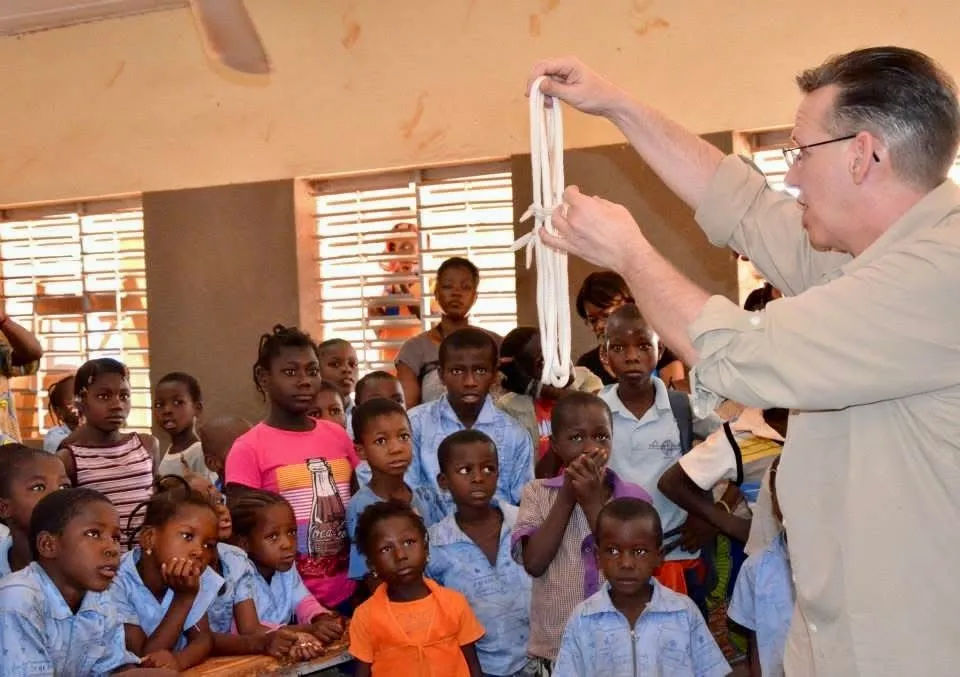
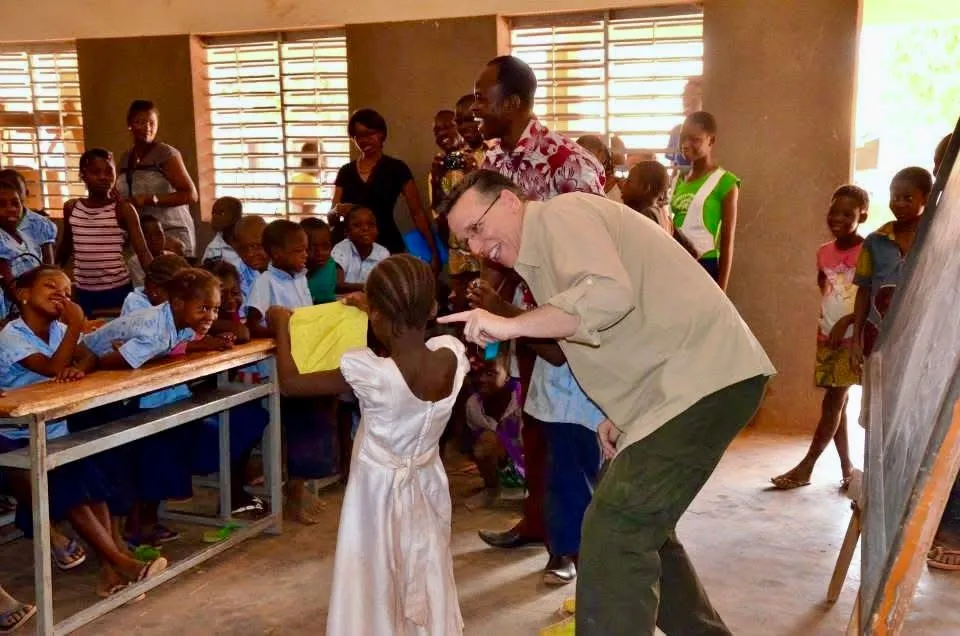
The classroom was open air, with no glass in the windows. The floor felt like concrete, but I think it was dirt, packed down hard over the years. They still used a slate chalkboard. Some of the students wore uniforms. There were 25 or 30 of them, a couple of teachers, and the four of us from Hope 4 Africa.
They don't get many Western visitors, and the kids were very quiet and very respectful. Then I started doing magic. Colorful silks that vanished. Pieces of rope that tied themselves into knots and linked together. They squealed with delight. I would guess none of them had ever seen anything like it.
We ate lunch with them, out at the school's outdoor kitchen, where the women cooked a giant pot of soup. I'm sure it was not crocodile soup. Probably chicken. And there was bread, because every culture has its bread.
All our hands together
At recess, the kids played in an open field. They all wanted to touch my skin, which was so much lighter than theirs.
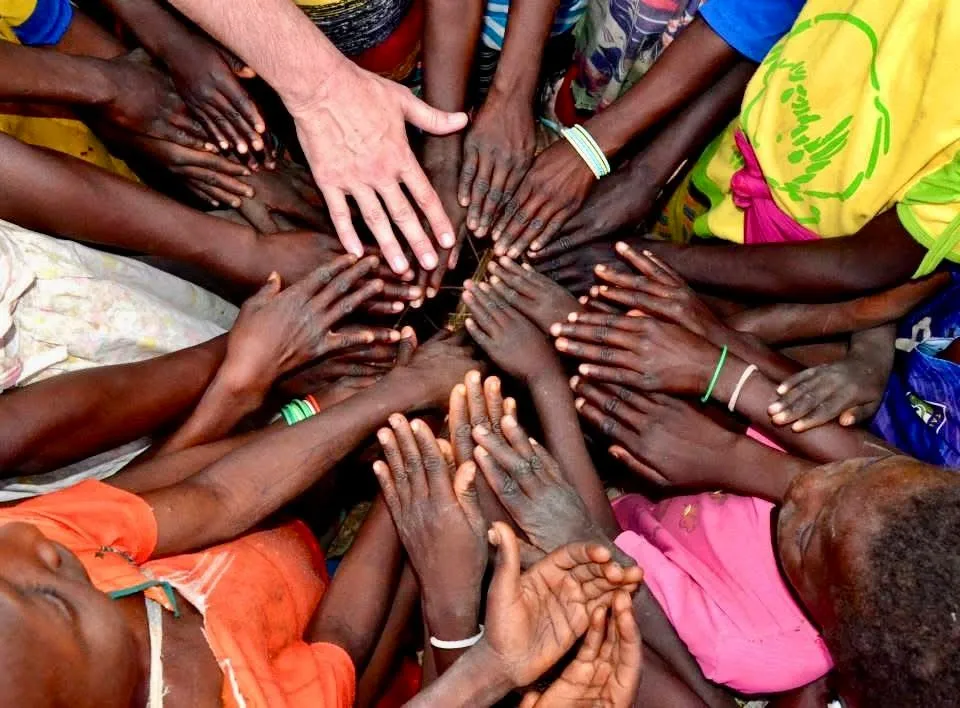
So I gathered them together. We didn't speak the same language, but I showed them what I wanted: all of our hands in the center, touching. Then I had someone take a picture from straight above, looking down.
My pale hand, in a circle of their small dark hands. I cherish that photograph.
The dance
In one of the nearby villages, we came to deliver microloans. About 70 women gathered in a half circle and sat the four of us in chairs at the open end.
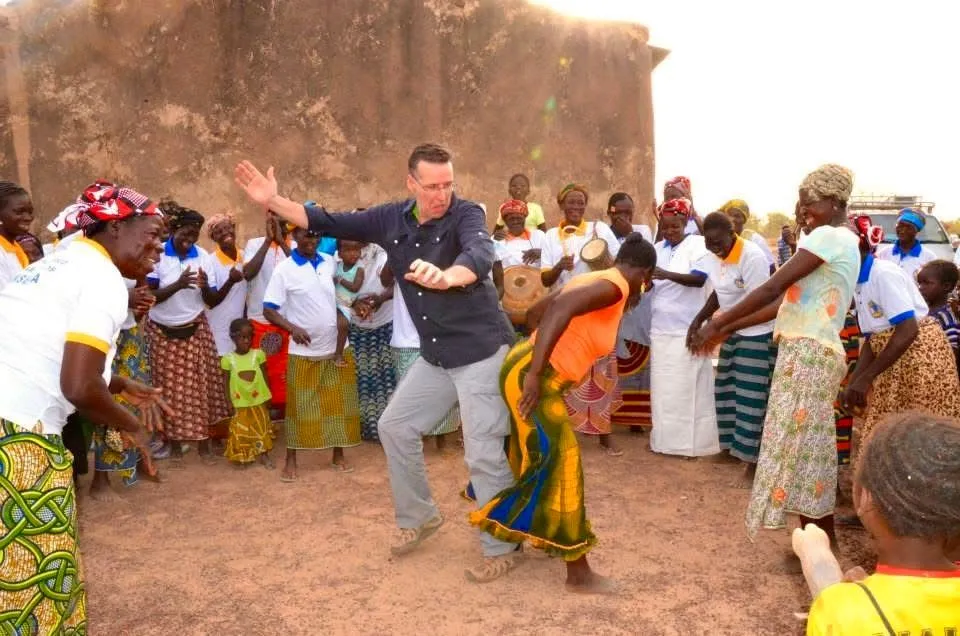
It was their welcome ceremony. They played drums and sang in their language, Moore, to welcome us and thank us. We didn't understand a word. We just knew they were grateful.
It went on and on. And on.
Paul has a great sense of humor. He leaned over and said, "You should get up and dance with them."
I said, "Are you sure? I don't want to cause an international incident."
He said, "No, it'll be fun. Go ahead."
I don't think he thought I would do it. I did. The women screamed with laughter. I have a video of it, and some photos.
When we walked back to the van, our driver, Dieoudane, and Jean were waiting there. Jean asked me what all the laughing was about. I told him I had gotten up and danced with the women.
He looked horrified. "You danced with the women?"
I thought, oh no. What have I done? For a second I almost told him I hadn't.
Then he said, "In my country, in my culture, a man who dances with the women is like a woman himself."
So we showed him the video. He saw the women laughing and having a wonderful time. I reminded him that I have a wife, children and grandchildren back home. He relaxed, and we were back in good graces.
A chief's hat under a mango tree
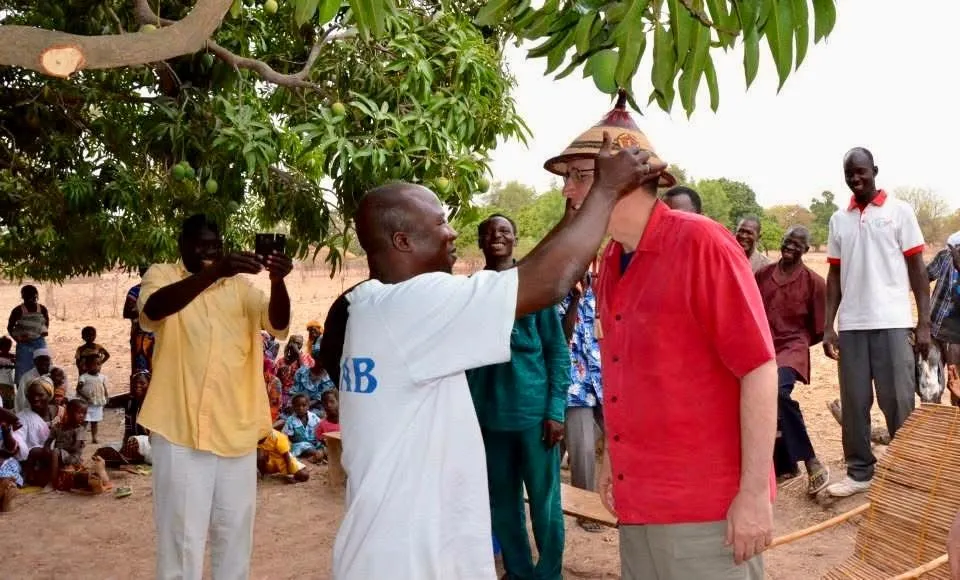
Later, in another village, Paul, his father and I were each given an African chief's hat. They held a ceremony in a clearing in the center of the village, under a mango tree, to thank us for coming and for the hope the microloans bring.
What I took home
By Western standards, those children are terribly poor. But their families band together, and their whole community takes care of everyone. We brought magic and a little money. They gave us laughter, a dance, a chief's hat, and a photo of all our hands together that I will keep forever.