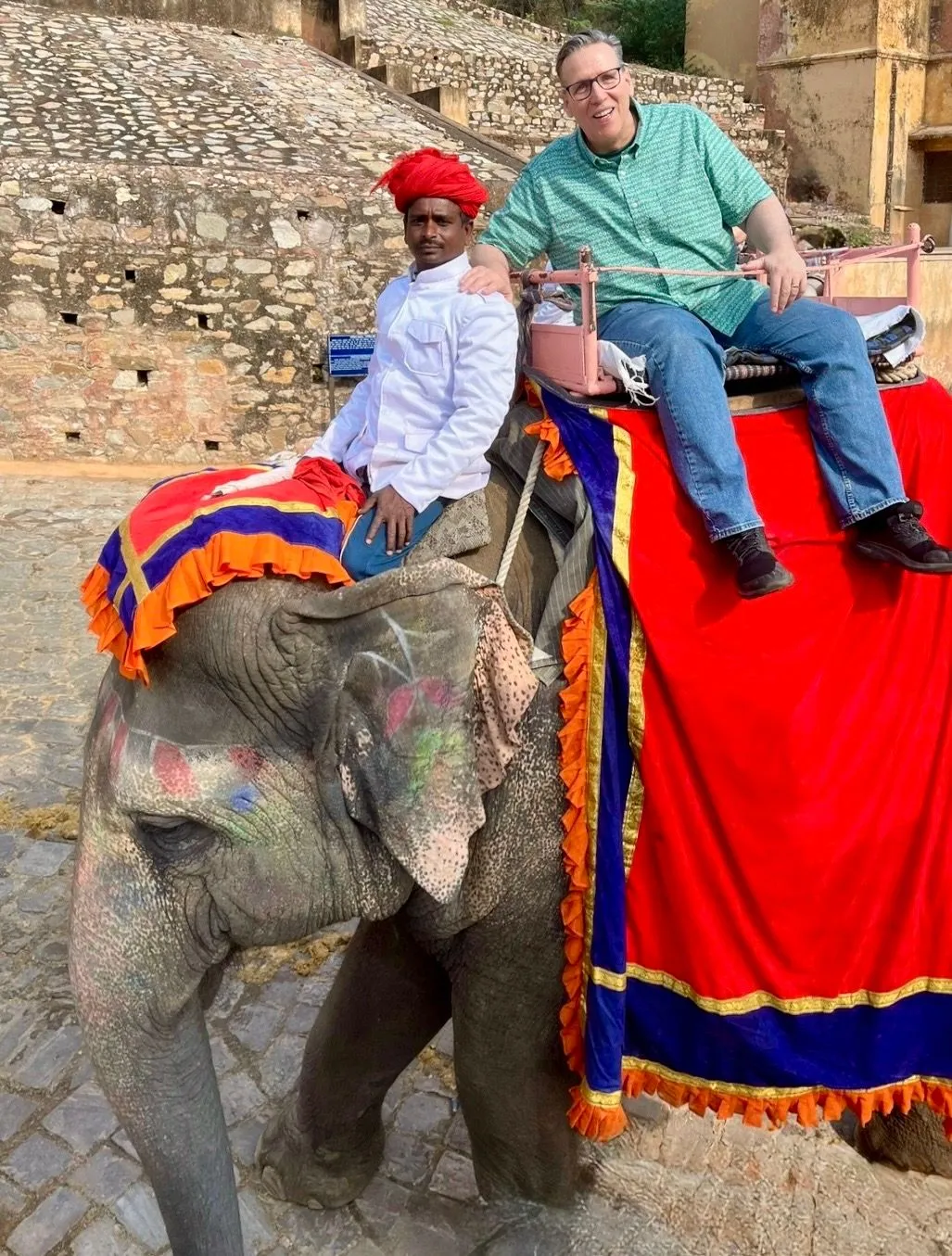
The elephant was a lot taller than I expected.
You climb on at street level, and then it walks you up a long road to the Amber Palace, high on a hill outside Jaipur, India. It takes 30 to 45 minutes. Nobody crosses in front of an elephant. Cars, people, everyone gets out of the way.
Up there, you tower over the people walking beside you. It was a little scary at first. After a few minutes I got used to it, and it was great.
This was the second leg of my trip around India's Golden Triangle, in March 2023. Part one was New Delhi and the Taj Mahal. This is Jaipur.
The Amber Palace
The Amber Palace, also called Amer Fort, sits on a hill about 7 miles from Jaipur. Raja Man Singh I started building it in 1592, out of red sandstone and white marble. It was the seat of the local rulers until they built the city of Jaipur in 1727 and moved down the hill. Today it is a UNESCO World Heritage Site.
"So many people"
Jaipur is several hours' drive from New Delhi. My driver told me we would go through a rural area on the way, and I was looking forward to it.
There was no empty countryside. Everywhere you look in India, there are people. Crowds and crowds of people, in the cities and along every road.
I kept saying to my driver, "There are so many people." He didn't speak much English, but he would say it right back to me, the same way I said it: "So many people."
India is about a third the size of the United States, with more than four times the people. Even the most rural road has people on it, walking to the market, to work, or to the temple.
The temples
We stopped at several temples along the way. In every one, a priest was reading aloud. It is very calming, almost like meditation.
I learned a lot about the Hindu gods. There are hundreds of them. Some are major gods, some are lesser ones. My guide explained that each person picks the god they want to worship, and that god becomes their favorite.
Three of the main gods stood out to me.
Shiva is one of the principal gods of Hinduism, the Supreme Lord who creates, protects and transforms the universe.
Vishnu is another of the principal gods, the god of preservation. He is the Supreme Being in Vaishnavism, one of the major traditions in Hinduism today.
Ganesh is one of the best known and most loved. You see him everywhere in India, and Hindus of every tradition worship him.
The cows
In the neighborhoods, you come across tiny temples and little altars, and live flower markets. At first I couldn't understand it. These people had very little money, and they were buying flowers.
Then I saw what they did with them. They made flower chains and draped them on their cows.
The cows wander the streets all day. They eat what they find, maybe in the spot where each neighborhood dumps its trash, maybe in a small field of grass. At the end of the day, they make their way back home. Nobody complains. That's just how it is.
My guide explained it to me this way. Hindus don't worship cows, but they hold them in the highest esteem. When a mother can't feed her newborn baby, the cow gives the milk. So people respect the cow the way they would respect a mother. I really liked that. It makes me smile just thinking about it.
As we drove, he also showed me how people dry cow manure into patties and burn them for fuel.
A wedding
While I was in Jaipur, I got to go to part of an Indian wedding. Those can last from several days to two weeks. I was there for a couple of hours, and I have a photo with the bride and groom.
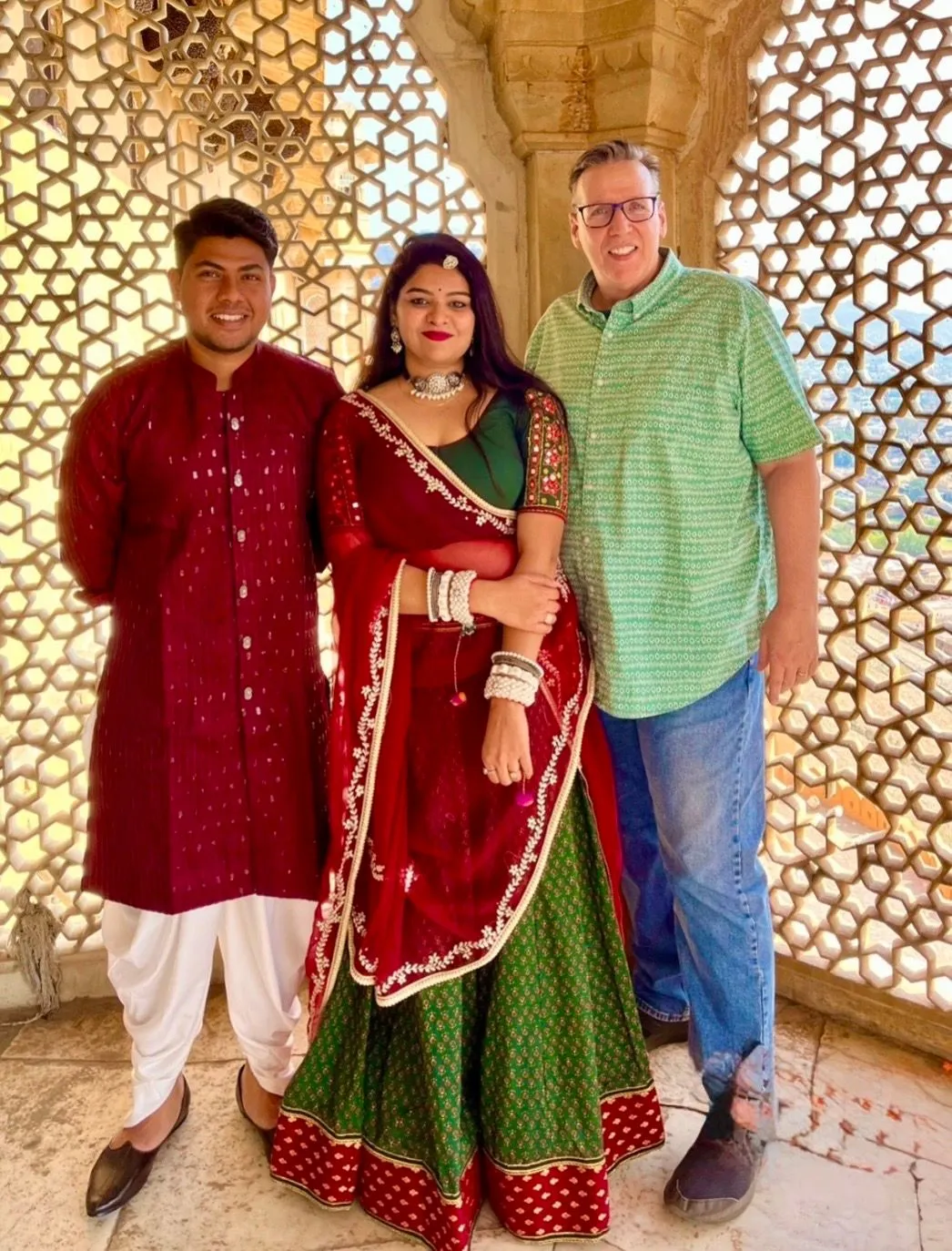
Here, a groom wears a black tuxedo with a clip-on bow tie, and it's no big deal. Over there, the groom wore a shiny suit of silk or satin. The bride wore a gown of silk in more colors than I could count. Her makeup was dramatic, almost like theater makeup. A chain ran through her hair and held a jewel just above her eyes, between her eyebrows. I learned later it is called a maang tikka.
Everyone was happy. It was a celebration, and the bride and groom were the center of all of it.
Two snake charmers
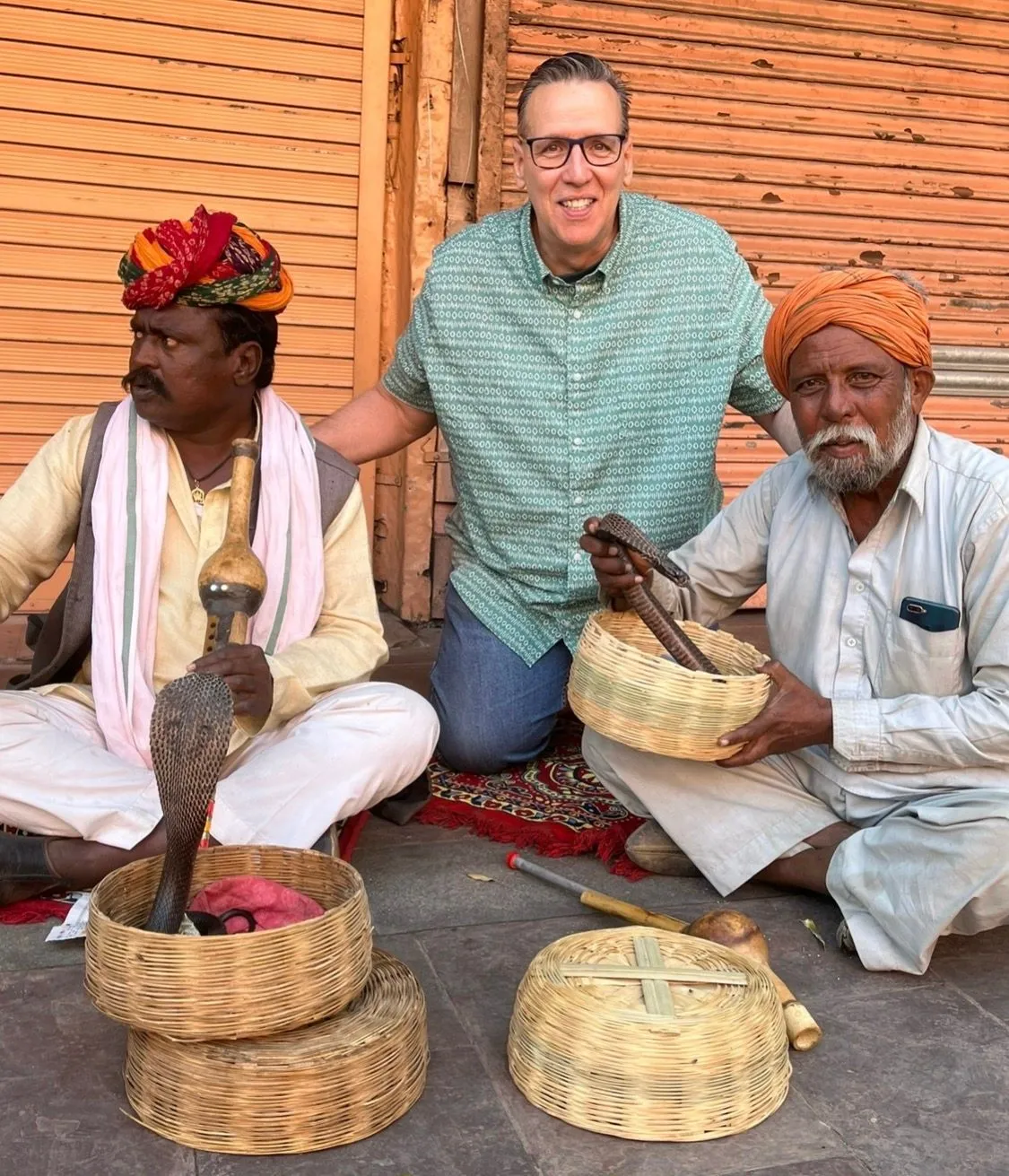
I also got to sit with two old snake charmers. I have a great photo of the three of us. Well, five of us, if you count the snakes.
The food
I'll be honest. I did not like the food. I couldn't find one traditional dish that I enjoyed.
But every culture has bread, and every culture's bread is delicious. So I lived on bread for a few days, until I found some American-style restaurants near my hotel back in New Delhi.
One was a McDonald's. It was fun to see how their culture shapes the menu. There are no hamburgers. Instead, it is chicken: a chicken patty, grilled chicken, breaded chicken, fried chicken. And a big vegetarian menu. Many Hindus are vegetarian, so every restaurant there has one.
What I took home
Everyone I met in Jaipur was kind. People with very little spent what they had on flowers for their cows. Strangers let me into a wedding. Two old men let me sit with their snakes.